
Quick take
- Pastel de nata is just the beginning — Lisbon’s dessert culture goes deeper.
- Dessert works best as a ritual: one stop, one seat, one slow coffee.
- Try a mix of creamy, cinnamon, and almond-forward sweets across your trip.
- Markets are great for sampling; cafés are best for lingering.
- Pair dessert with viewpoints and night walks for a romantic rhythm.
- If you’re doing a Sintra day trip, add a local sweet there too.
Beyond pastéis de nata: a simple Lisbon dessert menu
Lisbon’s dessert culture is built around pastries, custards, cinnamon, and almond-rich sweets. You don’t need to know every name — you just need a few categories to explore.
Try one classic, then one new thing. That’s enough to feel like you actually tasted the city.
- Custard-forward: pastéis and creamy pastries that feel like comfort.
- Cinnamon-forward: rice pudding-style desserts and café classics.
- Almond-forward: richer pastries that feel more ‘special occasion’.
Where to do dessert in Lisbon
Dessert is less about the exact place and more about the pace. Choose a café or pastelaria you like, order slowly, and make it a pause in the day — especially if you’ve been walking hills.
- Cafés: best for lingering and turning dessert into a ritual.
- Markets: best for sampling a few things without committing to one heavy choice.
- Neighborhood wandering: best for ‘we found this by accident’ moments.


A calm dessert crawl plan (romantic, not chaotic)
The best dessert crawl is not ten desserts. It’s two: one daytime sweet, one nighttime sweet. That’s enough to make it memorable without turning it into sugar overload.
- Day: coffee + one pastry.
- Night: one sweet stop after dinner, then a short walk.


Desserts on a day trip (Sintra bonus)
If you’re heading to Sintra, add a dessert moment there. It’s a fun way to make the day trip feel complete — and it’s an easy ‘treat memory’ for couples.
- Do your dessert stop in Sintra town, then return to Lisbon for a lighter evening.
- Keep dinner simple after a full day outside the city.
Why Portuguese sweets taste the way they do (convent pastry)
Most of Portugal’s classic desserts share the same backbone: egg yolks, sugar, and a lot of patience. This isn’t an accident. Many of the country’s most famous sweets — the doçaria conventual, or “convent pastry” — were developed in monasteries and convents, where nuns and monks used enormous quantities of egg yolks and sugar. (Egg whites were used to starch habits and clarify wine, leaving a surplus of yolks to turn into pastry.)
That history explains why so many Portuguese desserts are golden, glossy, and rich rather than light and airy. Once you understand the pattern, the menu stops being a wall of unfamiliar names and becomes a small family of variations on the same theme: custard, syrup, almond, and cinnamon.
It also explains the regional pride. Many towns have a signature sweet tied to a specific convent or recipe, which is why a day trip is a genuinely good excuse to try something you won’t find on every Lisbon corner.
- The throughline is egg yolks + sugar — expect rich, golden, custardy textures.
- Cinnamon is the default finishing spice; it shows up almost everywhere.
- Almond and squash (gila/chila) jam appear in the more “special-occasion” sweets.
Classic Portuguese sweets worth trying (beyond the nata)
You don’t need to memorise these — just recognise a few when you see them in a pastelaria case. Names and recipes can vary slightly by bakery and region, so treat this as a tasting map rather than a strict checklist.
A good approach is to pick one custard-forward sweet, one almond or convent sweet, and one homely café classic across your trip. That spread gives you the full range without turning every afternoon into a sugar marathon.
- Bola de Berlim — a Portuguese take on the filled doughnut, usually with egg-cream (creme); a classic beach and café snack.
- Travesseiro — a flaky almond-and-egg-cream pastry strongly associated with Sintra (a perfect reason to add a sweet stop on a Sintra day).
- Queijada — a small, firm cheese/egg tart; Sintra’s version is especially well known.
- Pastel de feijão — a sweet tartlet built on white-bean and almond paste (less famous abroad, very Portuguese).
- Arroz doce — cinnamon-dusted rice pudding; the comforting, home-style café classic.
- Bolo de arroz — a muffin-shaped rice-flour cake, a standard “with my coffee” pastry.
- Toucinho do céu — a dense almond cake from the convent tradition (rich; share it).
 Sintra day tripWhere travesseiros and queijadas are a local specialty.
 Pastel de nata guideStart with the icon, then branch out into the rest.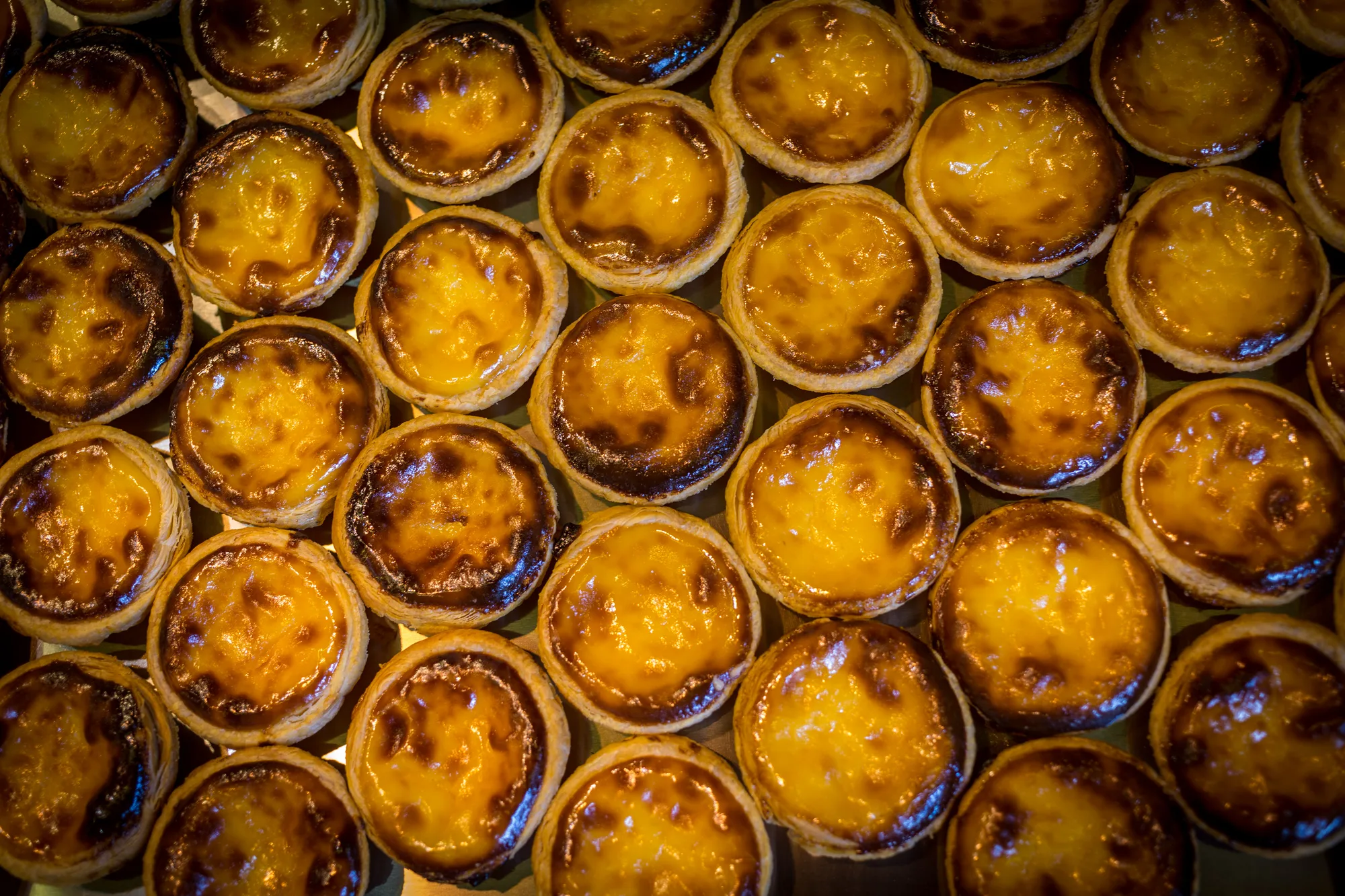
How to order in a pastelaria (without the stress)
A Portuguese pastelaria is part bakery, part café, part neighbourhood living room. The pastries sit in a glass case at the counter, and the simplest method is to point: you don’t need perfect Portuguese to have a great time.
Coffee is the other half of the ritual. A small espresso is a bica (or just café); if you want it with milk, look for a galão (tall, milky, in a glass) or a meia de leite (half coffee, half milk, in a cup). Pairing a strong, small coffee with a sweet pastry is the most Portuguese thing you can do, and it cuts the sweetness perfectly.
Prices and exact offerings vary by place and change over time, so check the counter or menu rather than assuming — but pastries here are generally an affordable everyday pleasure, not a splurge.
- Point and order — the case is right there at the counter.
- Standing at the balcão (counter) is often quicker and cheaper than table service.
- Pair sweet with bitter: a bica (espresso) balances a rich pastry.
- Mornings and late afternoon are the natural pastelaria hours.

Ginjinha and other sweet rituals
Dessert in Lisbon isn’t only pastry. Ginjinha — a sweet sour-cherry liqueur — is a classic Lisbon ritual, traditionally drunk as a tiny shot, sometimes with a cherry in the glass, often standing up at a hole-in-the-wall spot in the Baixa/Rossio area. It’s a lovely way to end a meal or break up an evening walk.
Pair it with the city’s pastry culture and you have an easy “sweet finish” to almost any night: one small sweet, one tiny glass of ginjinha, and a slow walk home. It’s low-effort romance that fits Lisbon’s pace.
- Ginjinha is served small — it’s a sip and a moment, not a session.
- Ask for it com (with a cherry) or sem (without) if you have a preference.
- A sweet + a ginjinha + a short night walk is a complete, calm evening.
Landmark places for Lisbon's classic sweets
Bakeries and pastelarias are one of the most stable parts of the city, so a few names are safe to seek out. Confeitaria Nacional, on Praça da Figueira and in the same family since 1829, is the historic house for conventual sweets and, around Christmas, its celebrated bolo-rei. For pastéis de nata specifically, Manteigaria (with counters in Chiado near Camões and at the Time Out Market) bakes in constant fresh batches and rings a bell when a new tray leaves the oven — a reliable, everywhere option.
For the famous version, Pastéis de Belém near the Jerónimos Monastery has baked its custard tarts to a monastery recipe since 1837; it's worth doing once, off-peak, as part of a Belém day. Beyond the tarts, look for Portugal's egg-rich doces conventuais — pastéis de feijão, queijadas, travesseiros — and finish with a ginjinha. Freshness matters more than fame, so a busy local pastelaria with fast turnover is never a wrong choice; hours can change, so check before a special trip across town.
- Confeitaria Nacional (Praça da Figueira): historic conventual sweets, same family since 1829.
- Manteigaria (Chiado / Time Out Market): reliably fresh pastéis de nata, batch after batch.
- Pastéis de Belém (Belém): the famous custard tart, baked to a 1837 recipe — go off-peak.
- Freshness beats fame: a busy local pastelaria is always a safe bet.
Pastel de nata guideThe custard-tart ritual, from Belém to Manteigaria.Best cafés in LisbonWhere the coffee-and-sweet ritual feels best.Ginjinha in LisbonThe cherry-liqueur finish to a Lisbon sweet tooth.Sources
- Manteigaria (official) ↗
Pastéis-de-nata bakery with counters across Lisbon.
- Pastéis de Belém: History (official) ↗
Background on the 1837 origin story and monastery recipe.
Where it is
Pastéis de Belém
The iconic Belém bakery (often busy). Best as a Belém add-on after Jerónimos/riverfront.
Map pins
Map data © OpenStreetMap contributors · Tiles © OpenFreeMap
Where it is
Time Out Market Lisboa (Mercado da Ribeira)
A central food hall inside Mercado da Ribeira — best off-peak for a calmer, more enjoyable visit.
Map pins
Map data © OpenStreetMap contributors · Tiles © OpenFreeMap


