
Quick take
- Alfama is the oldest and most atmospheric — go early for calm lanes and views.
- Baixa is the flat, rebuilt grid: best for orientation and easy walking.
- Chiado is café-and-culture Lisbon, between Baixa and Bairro Alto.
- Bairro Alto is quiet by day and lively at night — plan accordingly.
- Príncipe Real is elegant and leafy, with a garden-centered pace and local design.
- Belém is riverside monuments and museums; Parque das Nações is modern and spacious.
How to choose a neighborhood (and avoid the biggest mistake)
The biggest planning mistake in Lisbon is treating every neighborhood as a separate day trip. Many districts blend into each other — the best way to see Lisbon is to chain compatible areas into one walk.
Think in pairs: Baixa + Chiado, Chiado + Bairro Alto, Alfama + Graça, Belém + riverside museums, Cais do Sodré + waterfront evenings. Your legs will thank you.
- Rule of thumb: one ‘big hill’ neighborhood per day, not three.
- If you’re staying in Lisbon for 3+ nights, prioritize both a classic and a modern district for balance.

Neighborhood map (quick orientation)
Use this map as a mental model — not a checklist. Lisbon’s best days happen when you pick a cluster (old hills, central core, riverfront) and stay in it long enough to actually enjoy the texture.
Tap a pin to see a short note (and jump into the related guide).
Map pins
Map data © OpenStreetMap contributors · Tiles © OpenFreeMap
- Plan by gravity: go up once, walk down later.
- If you’re short on time: choose one hill cluster + one river/flat cluster.

The classic core: Baixa, Chiado, Bairro Alto
Baixa is Lisbon’s downtown grid, rebuilt after the 1755 earthquake. It’s where you reset your bearings, enjoy big plazas, and take a break from steep streets.
Chiado sits between Baixa and Bairro Alto, mixing theaters, shops, and historic cafés. Bairro Alto, perched above, is bohemian by reputation and most lively after dark.
- Baixa: flat, central, practical.
- Chiado: polished, cultural, ideal for cafés and browsing.
- Bairro Alto: nightlife energy; quiet mornings, loud nights.
Old Lisbon: Alfama & Graça
Alfama is Lisbon’s oldest neighborhood, spreading down the slope between the castle and the Tagus. It’s famous for historic streets, viewpoints, and fado culture.
Graça sits higher, with sweeping panoramas. Pair the two: start high for views and drift down through Alfama’s lanes toward the river.
- Best time: morning for calm; golden hour for glow.
- Expect stairs and cobblestones; wear shoes you trust.
- Plan one viewpoint stop, not five — the city is the same, your legs are not.

Leafy, local-feeling Lisbon: Príncipe Real & Estrela
Príncipe Real centers around a romantic garden laid out in the 1860s — a classic Lisbon square you can cross slowly, coffee in hand. It’s also known for design-forward shops and a calmer, residential feel.
Estrela is similarly relaxed and green, anchored by the Jardim da Estrela (a 19th-century park) and the Basílica da Estrela. It’s ideal when you want a quieter afternoon or a picnic break.
- Choose Príncipe Real for boutiques, gardens, and a polished-but-local vibe.
- Choose Estrela for park time and a gentler pace (plus classic architecture).
 Príncipe Real guideWhat to do around the garden, shops, and calm streets.
 Estrela guidePark time, basilica views, and a slower Lisbon.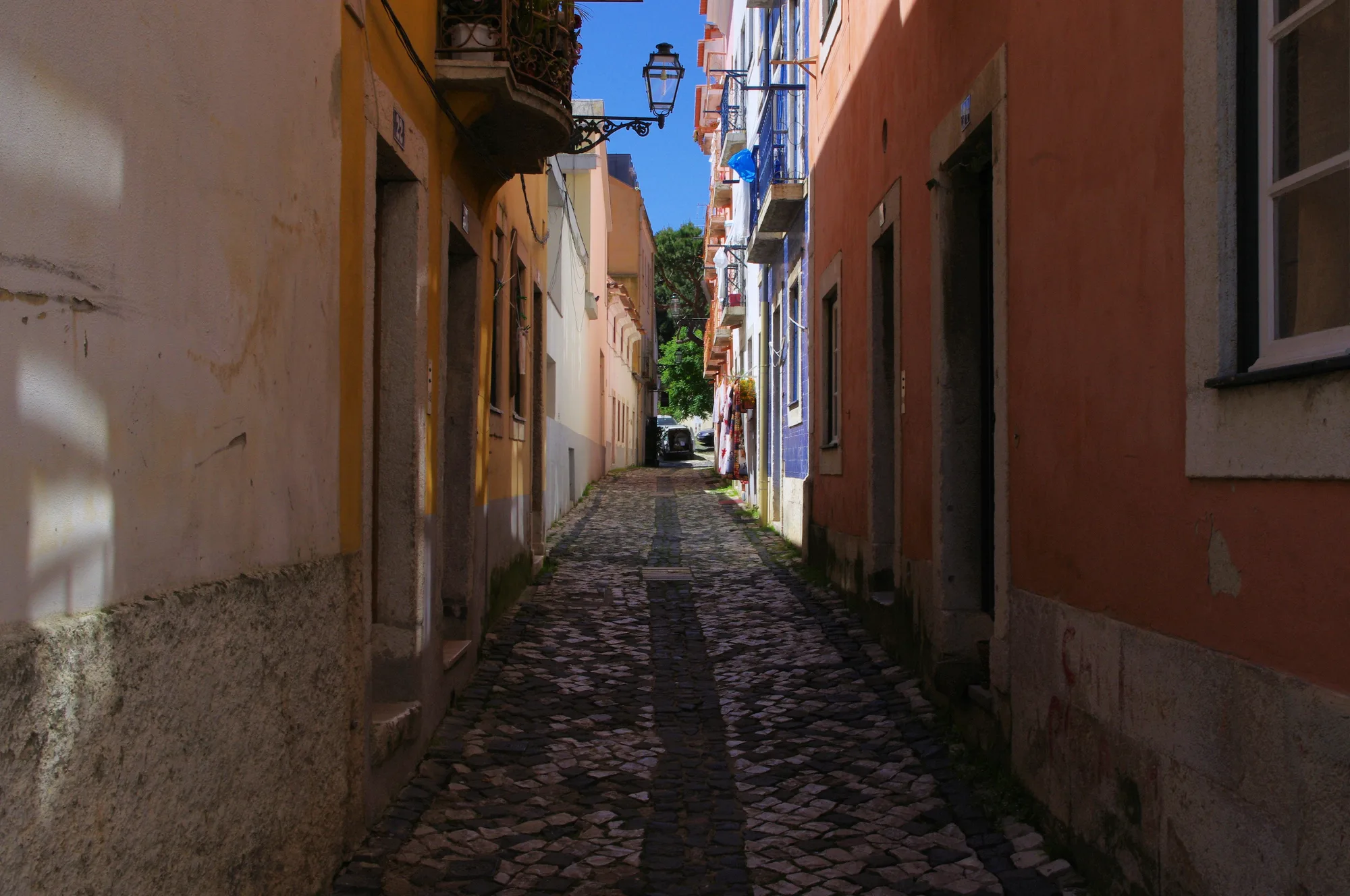
Riverside icons: Belém & modern Parque das Nações
Belém is Lisbon’s monument-heavy riverside: Jerónimos Monastery and Belém Tower are UNESCO-listed, and the whole area is built for easy walking along the water.
Parque das Nações is the city’s contemporary waterfront district, developed for Expo ’98. Think wide promenades, modern architecture, and the Oceanário — a great contrast to Alfama’s tight lanes.
- Belém is best as a half-day trip; pair monuments with a riverside walk.
- Parque das Nações is a ‘reset day’ neighborhood: spacious and low-effort.

Nightlife and waterfront energy: Cais do Sodré & Bairro Alto
Lisbon’s after-dark life concentrates in two adjacent zones. Bairro Alto is the classic bar-crawl grid: quiet, almost residential by day, then alive after about 22:00 as small bars spill onto the lanes and people drift between doorways with a drink. Cais do Sodré sits just below by the river and has shifted from rough-edged port district to a polished waterfront scene, anchored by the famously pink-painted Rua Nova do Carvalho (‘Pink Street’).
The two pair naturally: start with a sunset and small plates higher up, then descend toward the water as the night gets later. Both are walkable from the central core, which is why so many visitors base themselves nearby — but it’s also why light sleepers should pick a quiet side street rather than the loudest corridor.
- Bairro Alto: small-bar wandering; quiet mornings, lively nights.
- Cais do Sodré: Pink Street, the riverfront, and Time Out Market (Mercado da Ribeira).
- Sleep tip: stay near, not inside, the loudest streets — and bring earplugs if you’re central.
Mouraria, Graça, and the historic hill character
Just inland from Alfama, around the foot of the castle hill, Mouraria is one of Lisbon’s most layered neighborhoods — historically the quarter where Moorish residents lived after the Christian reconquest, and today one of the city’s most multicultural pockets. It’s often cited as a birthplace of fado, and it still feels lived-in rather than staged. Graça, higher up, gives you the big panoramas and a classic ‘start high, walk down’ day.
These hill neighborhoods reward the same approach as Alfama: go up once (by tram, lift, or a determined climb), then let gravity carry you down through the lanes. Midday crowds compress the narrow streets, so morning and late afternoon are calmer and more atmospheric.
- Mouraria: historic, multicultural, and a strong fado heritage — less polished, more real.
- Graça: panoramic viewpoints and a downhill route into Alfama.
- Best rhythm: climb first, wander down later; avoid the midday squeeze.
Creative and local-feeling Lisbon: Alcântara, Campo de Ourique, Alvalade
Not every great neighborhood is a postcard. West of the center, Alcântara has become a creative hub — its LX Factory complex turned a former industrial site into a cluster of bookshops, studios, food, and weekend browsing, sitting in the shadow of the 25 de Abril Bridge. It’s the easy ‘something different’ afternoon for design lovers and second-time visitors.
For a more residential, everyday Lisbon, Campo de Ourique and Alvalade are quietly excellent. Campo de Ourique has a relaxed grid of food streets and a neighborhood market; Alvalade is calm, leafy, and unhurried. Neither is a sightseeing destination — and that’s the point. They’re where the city feels like a place people live, which can be the best base for longer stays.
- Alcântara / LX Factory: creative browsing, food, and industrial-cool atmosphere under the bridge.
- Campo de Ourique: a local food-street vibe and an everyday neighborhood market.
- Alvalade: residential calm — good for longer trips and slower travelers.

How to choose where to stay (by neighborhood character)
Choosing a neighborhood to sleep in is less about distance — everything central is close — and more about hills, noise, and the mood you want when you walk out the door. The single biggest comfort factor in Lisbon is whether you have to climb home tired at the end of the night, so picture your evening return as much as your daytime sightseeing.
For a first short trip, the flat, central core (Baixa, with Chiado just uphill) is the easiest base. Couples and light sleepers often prefer the calmer-but-central feel of Príncipe Real, Estrela, or Lapa. Nightlife seekers stay near Bairro Alto or Cais do Sodré; families and comfort-first travelers like the spacious, low-stairs Parque das Nações. There’s no single best answer — only the best match for your trip.
- First-timers: Baixa/Chiado for flat, central, easy orientation.
- Couples / quiet sleepers: Príncipe Real, Estrela, or Lapa — central but calmer.
- Nightlife: Bairro Alto or Cais do Sodré (choose a quiet edge street).
- Families / low effort: Parque das Nações — modern, spacious, fewer stairs.
 Best areas to stay in LisbonA full breakdown of bases by vibe, hills, and noise.Príncipe Real guideLeafy, elegant, and central without the noise.Lapa guideQuiet elegance and a softer Lisbon rhythm.
A note on the 1755 earthquake (why the map looks the way it does)
Lisbon’s neighborhood layout makes more sense once you know about the 1755 earthquake. The quake — followed by a tsunami and fires — devastated much of the lower city. The reconstruction, led under the Marquis of Pombal, produced the rigid, rational grid of downtown Baixa (the ‘Baixa Pombalina’), built with early anti-seismic engineering and wide, regular streets that still feel unusually orderly today.
The older hill districts — Alfama above all — largely survived because they sat on more stable ground and outside the worst of the fire. That’s why Alfama still has its medieval tangle of lanes while Baixa below is a tidy chessboard. Understanding that contrast turns a walk from the river up into the castle hill into a walk through two completely different eras of the city.
- Baixa: rebuilt after 1755 as a planned grid — flat, regular, easy to navigate.
- Alfama: the old medieval tangle that survived — lanes, stairs, and layers.
- The walk up from Baixa into Alfama is, in effect, a walk through Lisbon’s history.
How to move between neighborhoods (the topography problem)
The thing maps don’t show you about Lisbon is the third dimension. Two neighborhoods can be a few hundred meters apart and still feel far if one sits at the river and the other at the top of a hill. This is why the city built funiculars (the Glória, Bica, and Lavra ascensores) and the Santa Justa Lift in the first place — to spare people the steepest climbs. Use them, and let the metro carry you across longer distances.
The practical strategy is to plan with gravity: ride or climb up once when you’re fresh, then let your wandering drift downhill toward the river and dinner. Tram 28 famously stitches several hill neighborhoods together (Estrela, Baixa, Alfama, Graça), which is part of its appeal — though it’s crowded at peak times. When in doubt, walk the ‘story’ stretches and use transit to skip the parts that are just uphill effort.
- Plan by gravity: up once, then drift downhill into the evening.
- Lifts and funiculars (Glória, Bica, Lavra, Santa Justa) exist to skip the steepest climbs — verify which are running.
- Tram 28 links several hill neighborhoods, but it’s busy at peak — ride early.
- Metro for distance; walking for the parts worth seeing.
Elegant boulevards and modern riverside: Avenida, Lapa, Parque das Nações
Beyond the old hills and the central core, Lisbon has a more spacious, 19th- and 20th-century face. The grand Avenida da Liberdade — a tree-lined boulevard of luxury shops and hotels — leads north toward the Marquês de Pombal roundabout and the Avenidas Novas district, planned in a wide, regular layout that feels worlds away from Alfama’s tangle. It’s a practical, well-connected zone, also home to the Calouste Gulbenkian foundation’s gardens and museums.
To the west, Lapa and Estrela offer quiet, embassy-lined elegance and green space. To the far east, Parque das Nações — the regenerated Expo ’98 site — is Lisbon at its most modern: wide promenades, contemporary architecture, the Oceanário, and a cable car along the river. These areas trade ‘historic postcard’ density for comfort and calm, which can be exactly right for families, longer stays, or anyone who wants a break from stairs.
- Avenida da Liberdade: a grand boulevard of shopping and hotels north of the center.
- Avenidas Novas: a planned, well-connected district with the Gulbenkian nearby.
- Lapa / Estrela: quiet, elegant, green — embassy calm near the center.
- Parque das Nações: modern riverside Lisbon — flat, spacious, family-friendly.
Neighborhood FAQ (the questions visitors actually ask)
A few questions come up again and again. Which neighborhood is ‘the real Lisbon’? There isn’t one — Alfama’s lanes, Baixa’s grid, Belém’s monuments, and Parque das Nações’s promenades are all genuinely Lisbon, just from different centuries. The richest trips chain several rather than searching for a single authentic one. Is Alfama too touristy? It’s popular, but it’s still a living neighborhood; go early or late and the crowds thin to almost nothing.
Where should I avoid? Nowhere blanket-‘avoid’ for safety in the central areas, but be crowd-smart for pickpockets on packed trams, at busy viewpoints, and in dense nightlife streets late at night. And how many neighborhoods can I really see in a day? Comfortably, one hill cluster plus one flat or riverside cluster — more than that and you’ll spend the day climbing rather than enjoying. Plan by character and topography, and the city stops feeling overwhelming.
- ‘The real Lisbon’? All of it — chain several districts rather than chasing one.
- Alfama crowds: real but beatable — go early or late.
- Be crowd-smart for pickpockets on packed trams, busy viewpoints, and late-night streets.
- Realistic per day: one hill cluster + one flat/riverside cluster.
Best neighborhood for your trip style
If you’d rather match a neighborhood to your travel personality than read every guide, use this shortcut and then go deeper where it points. The aim is to spend your time where the city’s character lines up with what you actually enjoy — atmosphere, nightlife, calm, or convenience.
First-timers do best anchored in the central core; couples and slow travelers gravitate to the leafy, quieter districts; nightlife seekers want the bar-and-river zone; families and comfort-first visitors love the flat modern east. There’s no wrong answer, only the one that fits the trip you’re trying to have.
- Atmosphere and history: Alfama, Mouraria, Graça.
- Central and convenient: Baixa, Chiado.
- Calm and romantic: Príncipe Real, Estrela, Lapa.
- Nightlife and river: Bairro Alto, Cais do Sodré.
- Modern and flat: Parque das Nações.


